
Contact Us Career Opportunities About Kaytee Email Newsletter Image Library
Kaytee Kaytee
Kaytee
Kaytee
What's NewWhat's New
Companion AnimalsCompanion Animals
Wild BirdsWild Birds
Product InformationProduct Information
Animal PlanetAnimal Planet
Avian FoundationAvian Foundation
Kids' ZoneKids' Zone
Store LocatorStore Locator
Ask The ExpertsAsk The Experts
Ask The Experts
Ask The Experts
Kaytee
Kaytee
Kaytee
Search:
Kaytee
Kaytee
Kaytee
Kaytee
Kaytee
Kaytee
Kaytee
Kaytee
Kaytee Ask The Experts » Cockatiels As Companions
Kaytee
Kaytee
Kaytee
Kaytee   Kaytee
Kaytee
Kaytee
COCKATIELS AS COMPANIONS

Where are Cockatiels from?
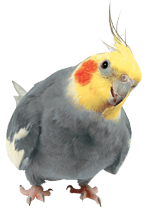
Cockatiels are America's fastest growing companion bird, and it's not surprising because cockatiels make delightful additions to almost any family. Originally from the interior of Australia, our domestic cockatiels' wild counterparts still fly in large, noisy flocks over most of that continent. In the home, they prefer to spend most of their time in or around their cage or on the arm of their caretaker. Cockatiels are fairly small companion birds, approximately 30-35 cm (12-14 in) long from head to tail and weighing from 75-105 grams (2-4 oz).

While many color variations exist, the most common cockatiels are grey with white wing patches. Both the male and female have yellow heads with orange cheek patches, but the male has much brighter, more extensive and more vibrant colors on the head than the female. The female usually has white and yellow horizontal barring across the tail feathers, while the male has a solid dark grey tail. Other common variations include the lutino (primarily white and yellow feathers), the pearl (small bits of white, grey, and yellow over the entire body) and the pied (larger blotches of white and yellow on grey).

Cockatiels are gentle and loving birds. Their disposition lends them to almost any household, including those with young children. Playful at times, a little scratch on the head is always appreciated by cockatiels. While their ability to speak is somewhat limited, their whistling abilities are chronicled; even complete tunes to songs can be learned. In general, the males are slightly better talkers and whistlers. The most loving and affectionate cockatiels are those that are hand-fed as chicks. With proper daily care, veterinary check-ups and the proper nutrition, cockatiels may live 15-20 years.

Mealtime Nutrition
Excellent nutrition leads to good health. For many years, people fed poor diets to birds, resulting in fragile and often sickly pets with short lives. Today, thanks to research such as the nutritional studies at the Kaytee Avian Research Center, we know much about the dietary needs of these animals. Birds are hardier, healthier and living longer, happier lives because their bodies are receiving the proper nutrients for good health.

"Standard seed mixes" were once the norm for pet birds. Today we know that a simple, seed-only diet is deficient in many nutrients, including vitamins A, D3, and B12, calcium, several trace minerals, and some amino acids (lysine and methionine in particular, two crucial building blocks of protein). Researchers at the Kaytee Avian Research Center developed blends to offset these deficiencies. These diets are supplemented with granules that contain the added nutrients your bird needs. "Fortified seed diets" are now preferred over the old "standard seed mixes" due to these added nutrients. For more information about KAYTEE fortified seed diets, check out KAYTEE Forti-Diet® on this website.

Gourmet diets are another type of fortified blend that combines a wider variety of specialty seeds, nuts, grains, dehydrated fruits and vegetables with extruded crumbles and pellets to ensure your bird receives all the nutrients it needs. These are one step up from the fortified seed diets by adding a bit more variety and excitement to mealtime. For more information about gourmet diets offered by KAYTEE, check out KAYTEE Fiesta® on this website.

A third type of avian food is called an "extruded diet". These foods do not contain seeds or grains, but rather take these natural ingredients, and through processing, create a nugget to form a nutritionally complete diet. After years of research, KAYTEE introduced exact®, a scientific formulation offering all the nutrients your bird needs in an easily digestible nugget. This type of food eliminates the guesswork from feeding because the bird can no longer just pick out and eat its favorite seeds or nuts. For more information about exact or extruded foods, check out KAYTEE exact® on this website.

Feed your bird on a regular schedule, feeding the amount recommended on the package label. Provide clean, fresh water at all times. Provide separate dishes (preferably protected from droppings for sanitation), for food and water. Add a third dish for Kaytee treats, or hang a treat stick in a convenient location in the cage. Fresh, darkly pigmented vegetables and very limited tropical fruits supply additional variety to your bird's diet, but are best used as a treat or training aid.

Home Is Where the Heart Is
Finding the appropriate enclosure for your bird is easy. Cockatiels need as large a cage as you can afford, but do best in a cage that is at least twice their wingspan and three times their length from head to tail. Bar spacing should not exceed 5/8", thus preventing your bird from putting its head through the cage, and should not have any sharp edges or areas where a toe, foot or wing could get caught. Although not true for all cockatiels, most prefer a square or rectangular cage rather than a round one.

Look closely at the construction of the cage you plan to purchase. Strength and durability are crucial. A nontoxic, safe material or finish is also important. Every cage needs a grate in the bottom to prevent your cockatiel from walking in its own waste. Of course, ease of cleaning is also a consideration. The perches in the cage must also be safe and sturdy. Several perches are best, varying the size slightly, although not cluttering the cage. Sand paper covered perches are not recommended by avian veterinarians because they can damage the underside of the foot and potentially cause lameness. Never locate perches over the food and water dishes. For more information about cages offered by KAYTEE, check out KAYTEE Cages on this website.

The bedding used in the cage bottom must provide absorbency and also ease of cleaning. Aspen, corncob, pine and cedar shavings, walnut bedding, and cage litters are all acceptable, but only when used in conjunction with a grate. Damp, highly soiled bedding poses a health risk to your bird so the bedding material must be cleaned at least weekly, but more often is better. An ideal litter is KAYTEE Bird Cage Litter because it forms clumps around droppings. This allows easy cleaning and disposal by scooping out waste and unwanted seed hulls or food.

Toys provide visual, mental, and physical stimulation for your companion bird when you are not available. Choose toys that are the appropriate size, again keeping safety as your primary consideration. Toys made of nontoxic materials are available. Do not overcrowd the cage with toys, however, instead, rotate toys through the cage periodically, keeping your bird's interest peaked. Bird play gyms are great for supervised activity outside the cage.

Cockatiel Characteristics
Weight: 75-105 grams (2-4 oz)
Length: 30-35 cm (12-14 in)
Wingspan: 32-36 cm (12-15 in)
Life Span: 15-20 years
Speaking: Moderate
Whistling: Excellent, can learn tunes
Notes:  Great family companion
Good with younger children
Kaytee
Kaytee
View Flash Intro
Kaytee
© 2008 Kaytee